


I always wonder how the heck do people make those crunchy but slightly hard-ish peanut crackers. I guessed two points are involved. It would be time consuming process. And it would be a super oily deal. I was right at both counts. But I took pleasure in learning how to do traditional dishes, and I am dipping my toes in the pond of traditional snacks making.
The peanut crackers (or rempeyek) are familiar snacks for people who live in rural areas, where Pringlers are as alien as touchscreen cellphone. The crackers are made from spice paste-and-rice flour batter and peanuts, fried to crunchiness. The odd ingredient is lime water (saturated calcium hydroxide solution, also known as air kapur). It gives batter the light and crunchy texture to fried goods. It can be omitted, if you don’t mind slightly hardish crackers, but you can always fry thinner crackers. That proves to be a bit of a challenge for me. As you can see, my crackers were a bit too thick. Practice does make perfect. After the 30-th cracker, I got a hang of it.
This is best served with Indonesian vegetarian salad, pecel. Also great for snacking with beer!

Ingredients would include raw peanuts. The thin brownish peanut skin is always intact. It gives the crackers the yummy earthy note. Spice paste are made from grinding garlic, candlenuts, coriander seeds, cumin. Kaffir lime leaves are sliced as thinly as possible.

The batter made from mixing rice flour and coconut milk.


I have been really busy for the past two months with work that eating out has been a luxury. When you are too wrapped up around your work and all its problems, it is very difficult to enjoy a decent meal. For the past couple of weeks I have been leaving work a little early, about 6 pm, and rush to a local hotel to hit their dinner buffet. The food is average, but there are a lot of selections to choose from, and getting there a little bit after 6 is great. The place is still quiet and the food is just served. Nobody likes to eat food that has been poked around by tens of people, nor do I.
I noticed for the past weeks that there is a Soto Medan soup served in the buffet line. No queue in front of it at all times, unlike the western food section. The last time I was there, the chef had some servers to prepare small bowls of the soup and offer them to diners at their table. Desperate much? When I tasted it, it was not bad, just a tad bland, not like what I have at home, or at local eateries. It then hit me, that this Soto Medan must be our city’s local signature, if Marriott includes it in their daily buffet menu, although not very successfully.
The soup is simple coconut milk-based soup, cook with spice paste and serve with condiments. Spices used that gives it the vibrant yellowish hue is fresh turmeric root paste. Almost all of fresh and dried spices found and grown in our region is used in the soup. The condiments are shredded chicken meat, bean sprouts, glass noodles and perkedel (potato patties). The soup is served warm with all these, sprinkled with shallot flakes, chopped spring onions and Chinese celery and liberally dosed with kecap manis (sweet soy sauce).
The secret of getting the best soto is fresh coconut milk, high heat when cooking, and constant stirring.

We grow our own turmeric roots in our front yard. They are easy to grow, and the leaves can also be used for cooking too. The leaves gives the dish turmeric flavor, without the color. This is not used in soto.

The way to enjoy soto is with a plate of warm steamed rice. Pour some soup on top of the rice, scoop up some condiments together with perkedel. Some likes to enjoy it the other way around. The rice goes into the bowl, instead of the soup on top of rice. Either way, it is delicious.


Potato frikadel or perkedel kentang is our answer to mashed potatoes. Mashed potatoes is mixed with spices such as shallots, garlic, candlenuts and white pepper. Add in chopped Chinese celery and spring onions, then shaped into patties. Little round patties are then dipped in eggs and deep-fried till golden. The perkedel patties are usual condiment to a special coconut-based chicken soup.
Funnily this is a great way to use up leftover potatoes in other dishes. KFC in Indonesia has this in their fixed menu. The culprit should be leftover french fries. Potatoes have always been deep-fried till golden before mashed. I tried boiling, the patties are soggy uncontrollably when shaped. Roasting might work, but I have never tried it.

Spices to be ground are shallots, garlic, candlenut and a bit of pepper.

I used assortment of potatoes – a couple of big giant ones and some reddish smaller ones. I am sure they have a couple of names to go with them but I have no idea what they are.

Deep-fry potato pieces in hot oil till golden.

Try poking one of them with a fork. If it goes through without much resistance, it is cooked and remove from the oil.


Indonesian food is rich of deep-fried snacks. That might have something to do with the teensy weensy fact that the country is one of the main producers of palm oil. Cooking oil is abused to the letter. It is the way of life, the fried food. We can’t do much, since we can’t really start boiling everything. What we can do is to enjoy it and do so prudently. We can make fritters out of everything. Sometimes with something as lame as cabbage and a bunch of leftover vegetables. This is one of the food item that is enjoyed as afternoon snacks, together with corn fritters and banana fritters.
This vegetable fritters, or bakwan sayur, are bit tedious to make at home, I personally don’t like to spend too much time chopping vegetables. Once a while it is a nice treat to make at home. Tasty way to use up vegetables beside stir-frying them.

Spices to be ground is almost the same as the one used in corn fritter. Shallots, candlenuts, garlic, white pepper, ground coriander, salt and sugar. Grind this in a mortar and pestle till fine.

Vegetables used are carrot, beans sprouts, cabbage, spring onions and Chinese celery with some chilies. Combine all these in a big bowl.


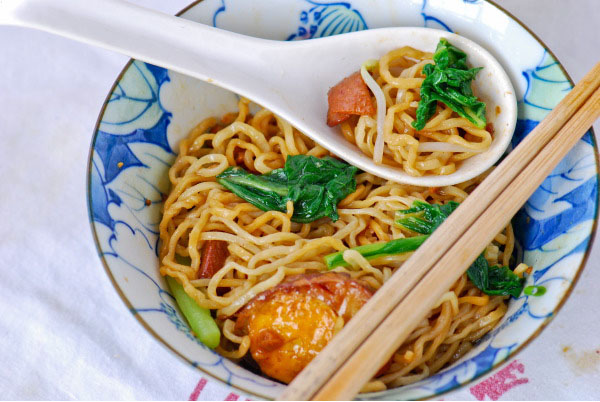
Happy mother’s day! Strangely we have a whole different day for Mother’s Day, which would be December 22. There’s no harm in celebrating Mother’s Day twice, in fact, we should be celebrating our mothers everyday. They are the very reason for our being. With that being said, I am sharing a recipe from my mother of simple Chinese rice noodle stir fry (kwetiau polos). It is the most common and greasiest breakfast item, and most loved. It is even falsely perceived to be the healthiest, since it has nothing else in it but noodles and a bit of greens. Simple = healthy? Our mornings would start with iced drinks, sometimes hot coffee, a serving of stir fry rice noodles, morning paper and early morning gossip of neighbors and relatives over breakfast table.

Mother loves her stir-fry cooking in the front yard. She moves her little gas stove on small wooden table out to the garden when she is going to cook stir-fry. She is not a fan of fancy gas standing cooker. I wonder if she would change her mind if she sees a Wolf or a Viking. Fortunately the whole thing works really well for me since the yard is brightly and naturally lit (obviously) which explains most of the step-by-step shots in this blog. I set tripod next to the gas and sometimes I catch nice greeneries on the background whilst shooting.

Here we go, some fresh rice noodles. Rinse noodles in cold water to get rid off excess oil. If dried stick rice noodles is used, soak them according to instructions on package.

Bean sprouts and chopped spring onions. We feel the absolute necessity to pick off the itty bitsy end of the sprouts, which is one of the most tedious chores in Chinese cooking.

Some Chinese mustard greens. It is in the same family as bokchoy, but thinner and longer, sometimes with yellow flowery stalks in the middle part. Also known as chaisim or sawi hijau. Substitute with bokchoy if not available.