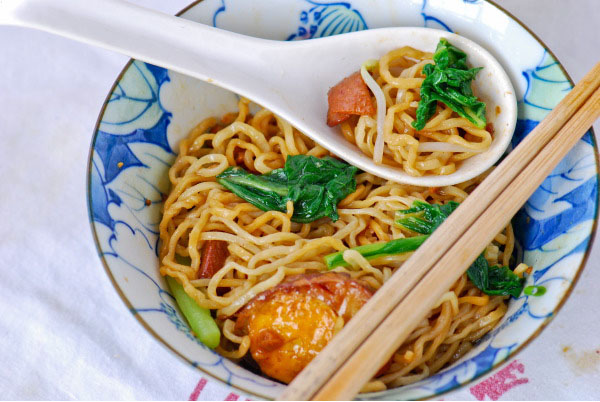

Lunch for us would consist of two stir-fry dishes and one serving of soup. We all work in the same office, in a family owned factory. My father, my brother and my other half would have lunch together in the office. Lunch is prepared at home and delivered right before lunch break. We almost never eat out during lunch time, since our office and factory is quite away from city center where most restaurants, malls and cafes are located. Our lunch break is only one hour, and all of our staff also bring lunches from home. We have ours in our meeting room and they have lunch in staff dining room. Okay, our lunch is very boring. When I worked at a local bank, we would have lunch out every single day. In a pack, led by our team leader. Five days a week we would eat at restaurants and cafes, highs and lows. Things are very different now.
I am very interested at what people have for lunch. I think you can be very fancy during dinner. But lunch, when squeezed between tight schedule and traffic jams and phone calls, you have to take what you can and when you can.
Mother and Pai prepare lunch at home, sometimes Pai is the one who does the shopping early in the morning to buy food ingredients. When she (and mother) runs out of idea of what to cook, then the vicious cycle begin. I mean, it is only natural, that she would go back cooking the easiest and fastest dish. What usually do you have for lunch?
This dish with long beans and eggs repeats itself a lot in our lunch menu. And I mean, a lot. It is easy and nutritious. Take care when frying after eggs are added. Stir quickly and remove, over cooking will result in dull looking eggs.

Heat oil and stir fry garlic till fragrant

Add cut snake beans into the wok and stir-fry quickly till they half-cooked.


Living in a tropical country with nearby high altitude farms does have its perks. I get to experience skin-scorching hot weather, that might cause me to develop freckles prematurely. And I get a whole lot of fresh produce within 2 hours drive from my home and office. My business partner started a community based strawberry farming to maintain steady supply of strawberries to our bakeries. We provide fertilizers, seeds, seedling, bags. In return, we get to buy a portion of each farmer’s harvest every day. I have been silly not to use strawberries more in my cooking and baking.
A couple of weeks ago I ordered a box of strawberries, again, thinking I would make strawberry pie. Weeks gone by, and the fridge I used to store these are our backup fridge. Yeah, my mother needs two fridges. At some point last year, we actually got three. And there are four of us in the house with three fridges. So the backup fridge doesn’t get opened very often daily. When I checked a couple of days ago, I was shocked that I completely forgot about the berries. Okay what’s the fastest way to use these frozen and overipe berries?

Summer. Strawberries. Sorbet. Those three words sum up the whole thing rather nicely, don’t you think? I got my recipe inspirations from various recipes. Some recipes calls for more sugar, but my berries were already passed the expiration date, so I am not sure that’s the way to go. Then I read a recipe with some lemon slices. Sweet and sour are always my thing. And a dash of alcoholic beverage would smooth up the sorbet. There you go. This becomes a hit at home. It doesn’t taste like sorbet, with frozen juice and all. It almost has the consistency of an actual ice cream. I swear.


This is one of the super auspicious Chinese New Year vegetarian stir-fry dishes, that we have all year long. Mainly because it is seen as an one-pot dish for lunch, dinner, tomorrow’s lunch and dinner. The dish can basically last all week. The dish is cooked in big batch, as a lot of ingredients are used, even if you use only a little bit of each, you would end up with a big pot of food that you might need to distribute to your neighbors, drivers, mall’s security guards and parking attendants.
Since mother is getting a bit forgetful by the year, every time she cooks this dish, she would leave out one of two ingredients. I don’t know if it is done intentionally or not. Let’s not turn that stone. This is the most complete version, with everything that is supposed to be in there, is in there. My mother learned this from my paternal grandmother. My grandmother didn’t leave a lot of cooking knowledge to her, but this is the one that my father always requests and we all love. She is in a good place now.
I always find it odd how a lot of food item considered auspicious in Chinese cuisine are dried. It is a question I don’t know whom to ask that to. The chap chye uses many dried food items. Some needs to be soaked. Others need to be soaked, then fried, then soaked again.

A lot of ingredients to be prepped. I’d start with dried ones. Black fungus needs to be soaked for an hour before using, till it fluffs up and fully hydrates. Cut off the middle part that’s tough, it is never delicious. Brown dried bean curd skin is soaked till soft. Mushrooms is to be soaked till soft and cut off the stem, then sliced thinly. Gingko nuts are to be cracked open and the thin brown layer of skin to be carefully peeled off.

Fresh ingredients to be prepared are cauliflowers, choy sum or any Chinese greens, cabbage and carrot.


Have you ever had that moment when you pick up stuff from the supermarket with this super smart and smug thought that you would make something impressive out of it? And then, four months later, the stuff is still in the freezer, crying for help silently? I do. All the time.
This time I would like to present the long forgotten spring roll wrappers, made into spring rolls. Inspired by how much I have posted deep-fried food for the past months, I baked those rolls against my nature. Turned out pretty good. I have to admit that they looked like a bunch of sick rolls. But they are crunchy enough. And the fillings are easy to prepare and quite awesome. Some mysterious skills are needed to master baking rolls into nice golden brown. Anybody care to share those skills with me?
However, the main satisfaction is that I have saved myself some grocery money by skipping the one litre of cooking oil needed to deep-fry those rolls.
I made a vegetarian version. For the meat lover in you, add some ground chicken or prawn.

Stir-fry chopped garlic and mushrooms with a bit of oil over high heat.


The little sister of the big and savory rice dumpling is the sweet rice dumpling, also known as alkaline dumpling, or kee-chang. This is also the first time of me making it.
Alkaline dumplings are always treated as dessert. Alkaline solution used in glutinous rice give them bright beautiful yellow that is almost luminous hue. The dumplings are bland by itself, so it is always served with thick syrup made of gula merah (gula melaka or palm sugar) and coconut milk. For some, it is also eaten with coconut jam (srikaya). Again, this is one of those cultural food items that we grow up and develop taste to. When you are used to gula merah syrup, you will feel it is not complete without it. If you grow up with taking kee-chang with coconut jam, you will probably stick with it for the rest of your life.
Only two ingredients are used for kee-chang. Glutinous rice and alkaline water. If you want your dumpling to be smooth and springy, you need to be willing to live dangerously for one day a year and add a pinch of borac acid (also called “peng seh“). Mother, and her mother, always adds that infamous ingredient into their dumplings. I believe it is a banned substance for any kind of using in food in a lot of countries. I have never had dumplings without it.

The glutinous rice needs to be of the best quality. Rinse well and soak overnight. On the day you plan to make the dumpling, drain the rice and place in a big bowl, enough to hold the rice. Add alkaline water into the bowl.