



It is strange that we don’t use lotus root enough in our cooking. It is crunchy. It is starchy. It is very cute. It is also my most favorite root vegetable. We only use lotus root for pork rib soup. Lotus and pork soup is as homey and heart-warming as Western-style chicken soup. The three most important ingredients are fresh groundnuts, lotus roots and pork ribs. For sweetness, tomatoes or carrots are usually added. For that extra flavor, dried seafood bits are used. This can be dried scallop or dried oysters. Sometimes a pinch of dried shrimp is added in absence of scallops and oysters.

Wash the roots and peel using your peeler. Slice them into 1 cm thick round slices. Too thick would not be nice to bite, too thin slices would cause the root to fall apart after hours of cooking. 1.5cm thickness is the right way to go.

Read More

Perut Ikan Nyonya

We grew up eating this never knowing the name. My auntie’s mother in law was from Penang and she taught her many years ago. My mother and I really love this although we only refer to it as “That Nyonya Dish”, but none of the family knows how to cook. Auntie makes a big batch and distribute to everybody once in a while and it is kept refrigerated and enjoyed sparingly. She showed me how to cook this and she claimed that I am the second person in the family who knows the recipe.

I did some reading and found out that most of the Penang versions are prepared without coconut milk. Our version is prepared with coconut milk and very rich, almost resembles very spicy and pungent curry dish. My auntie is a vegetarian, and she couldn’t shop for fish stomach (or perut ikan). So she omitted that particular core ingredient and substituted it with dried salted fish. I have never had pickled fish stomach before, and it is certainly not sold here. Again, very sorry for the perut ikan recipe, without the perut ikan (fish stomach).

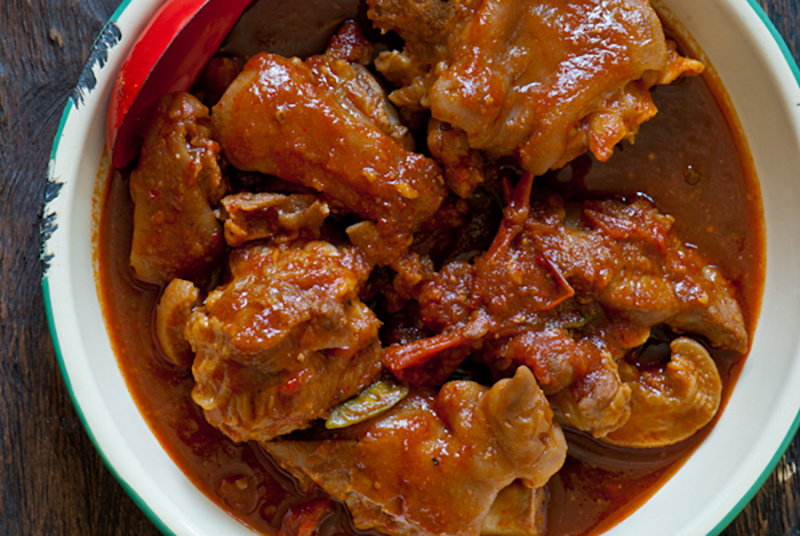
The flavor of the dish only improves with time. The texture is soft and mushy, but you can actually taste each ingredient in every bite. The pungent smell of shrimp paste and shredded herbs are so beautiful. If you are wondering how the Chinese Straits cuisine taste like, this bowl of dish sums everything up pretty nicely. The dish is served with hot steamed rice.

The main herb ingredient is the betel leaves (or daun kadok) is not sold in the market. The betel leaves we have in our area is the narrower and longer type, also known as daun sirih. These particular leaves are round. My auntie has very keen eye, that when she is out on a tricycle riding around town, she takes notice of people’s front yard. She knows which houses grow the leaves. We went for betel leaves hunting a couple of weeks ago, snatching a bunch of them off people’s front gate and on the side walk. I decided that I am going to grow this on my front yard so she doesn’t have to pick them off people’s garden. I think it is now growing, but it would be a couple of months till I can harvest the leaves for cooking.

I can’t help but thinking how strange this is, with all the similarities of our Medan dishes with Penang, this is the one that we don’t have. I am so grateful to be able to learn this. The following step by step is done in panic, as there are so much ingredients that would go in there and so little time to do it. I have to do the washing, the cutting, the grinding, the shooting and the step-by-step shoots. I didn’t manage to get every single shot, but I will try to explain the steps that I missed.

Read More

Chocolate Sherbet

What is that ugly melting but yet freezing bowl of ice cream there, you might wonder. I am on the verge of giving up taking shots of ice cream, but this is just too delicious to let pass. Chocolate sherbet is one of those ice cream that I make repeatedly. No one in the house actually share my love for bitter but sweet chocolate, so I am at bliss.

I think David Lebovitz is the most generous guy in the world. Very often I meet those who are so unwilling to share recipes, but he shares so generously on his site and his fabulous books.

Read More

Ginseng Chicken Soup

Chinese love soup. Soup enriches by dried herbs, slowly steamed or simmered with low heat for hours, is one of the staple in home meals. Our soup is usually cooked with ginseng and chicken, steamed till all the goodness of all ingredients can be sipped in a bowl.

A good bowl of soup needs to have four types of ingredients, and each one balances the others out, which is one of the most important traditional Chinese cooking principles. Animal protein, that can be simmered for a long period of time slowly to get the juices out, is usually a choice of whole chicken or pork ribs. Sweet dried herbs that gives the soup that sweetness, these are dried fruit, such as longan or lychee. Bitter herbs are normally variety of roots. Choices of bitter roots are ginseng, angelica roots, or other type of roots. The last type of ingredients is the neutral ones, these could be wolfberries (or gojiberries), dried mushrooms or lotus seeds.

This recipe is what we love to cook at home. The ingredients are very easy to find in any Chinese herbal shops.

Herbs we used are dried longan, dried lychee and dried wolfberries. The roots are American ginseng, angelica root and red sage roots. Crack dried fruits with back of knife. Use the soft fruit part only. Run all ingredients under cold water to wash dust away.

Read More

This food item is truly loved by many. I particularly love them. Famously known as “ham cim peng”, it is simple fried bread that has been around for many years. I don’t know what is the history or where it actually came from. It is sold by street vendors or small local market hawkers only during morning hours. It is something needs preserving and more appreciation. Cheap street food doesn’t mean it is junk. Do it the right way and enjoy it moderately.

On a typical Sunday morning, I would find some traditional Chinese ham cim peng fried bread on breakfast table. It is a tradition for us to have these bread for breakfast. The bread are deep-fried and warm, served over a cup of coffee. Families and guests could sit for hours enjoying them. Of course I always suspect it is a week’s worth of hot gossips over other relatives or acquaintances that make them eat these bread so slowly. But I do love them. The bread is soft with a lot of holes in the middle. The flavor of sesame seeds and five spice powder blend nicely. It is warm. It is simple. It is familiar. It smells like home. It is love.

When I came across this recipe and was shown how to do it, I was over the moon. Although my family (and people whom I talked to) thought I have gone mad for making these at home, since it is very, very cheap to buy, I truly enjoy making them. It is very easy to make, despite the fact that you might need liters of oil to fry. The steps are pretty straight forward.

The key to getting nice and fluffy fried ham cim peng is good quality wok (as thick a bottom as possible) and  hot cooking oil. For those who are familiar with the bread, you might see that your bread would be lighter color. That is because you are using fresh cooking oil. The hawker sellers are using oil that has been used many times, that gives the nice dark brown color. I did try to fry them longer to get the dark brown color, but they turned out to be burnt. So do fry them just long enough. Golden brown is nice.

This can be made without mixer. For the amount of the recipe I am making, people usually knead by hands. I just love using the mixer so much. In a bowl, combine sugar, yeast, baking soda, salt and water. Whisk till sugar dissolves.

Add flour and distribute evenly with rubber spatula.

Knead using hook attachment, slow speed, about 4 minutes. Kneading by hands would be folding technique, lightly, about 8 minutes. Covered and leave in bowl for 15 minutes.

Read More